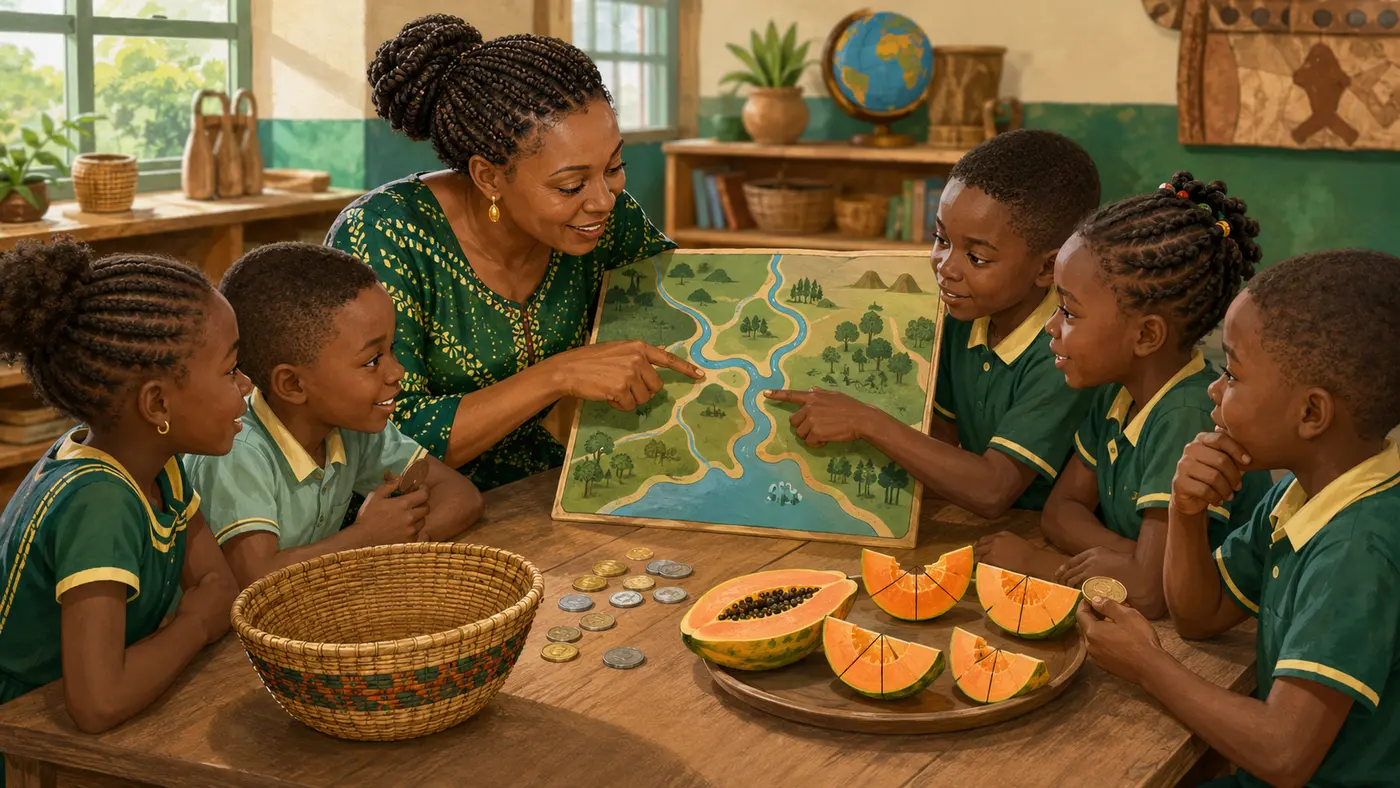
Children understand new ideas more easily when a lesson begins with something they recognise. Fractions can start with sharing puff-puff or a pawpaw. Distance can begin with journeys between neighbourhoods. Trade can begin with a familiar market.
Local context does not mean replacing universal knowledge. A river remains a river and multiplication remains multiplication. Context simply provides a bridge between the concept and the learner’s daily experience.
Teachers should use Cameroon names, places and experiences naturally—not force them into every sentence. The best example is accurate, age-appropriate and connected to the objective.
Local examples also create opportunities to learn more about Cameroon. Reading passages can introduce Mount Cameroon, the Sanaga, Waza National Park, local occupations and the country’s cultural diversity while still teaching language skills.
Good localisation begins with the objective, not with decoration. If a Mathematics lesson teaches subtraction with regrouping, a FCFA purchase can provide a believable problem. If a Science lesson teaches evaporation, wet clothes drying after rain may offer a clear observation. The example should make the idea easier to investigate. Adding the name of a Cameroon town to a question that otherwise makes no sense does not improve learning. Teachers should ask whether the context contributes information, supports reasoning or gives the learner a useful mental picture.
Accuracy matters because local examples often carry knowledge beyond the main subject. A reading passage about a river, historical event, ethnic group, crop or region can accidentally teach misinformation while assessing grammar. Check names, dates, locations and cultural claims before using the text. Avoid writing as though one food, language, dance or family practice represents the whole country. Cameroon’s regional, linguistic, ecological and urban-rural diversity should appear across a term rather than being compressed into one stereotyped description.
Localisation should also include ordinary contemporary life. Cameroon is not only traditional clothing, village scenes and famous landmarks. Learners recognise apartment buildings, taxis, mobile money, football fields, health centres, farms, offices, workshops, roadside businesses and digital devices. Balanced classroom materials can move between rural and urban settings and show girls and boys solving problems, building, leading, caring and creating. This helps children see their present lives as worthy of serious study while still learning about heritage and history.
A teacher can deliberately widen knowledge by rotating locations. One week a passage may begin in Douala; another may explore Buea, Ngaoundéré, Bertoua, Maroua, Ebolowa or a smaller community. Maps and verified photographs can help learners locate places rather than merely memorise names. The aim is not to mention every region in every lesson. It is to prevent the repeated use of one city or cultural group from becoming the learner’s entire picture of Cameroon.
The final safeguard is the teacher’s question: would a learner from the place or community being described recognise this account as respectful and believable? If uncertain, consult an official source, a reliable publication or a knowledgeable person, and present variation honestly. Locally grounded teaching is strongest when it combines familiarity with curiosity. The child begins from something understandable, develops the required academic skill and leaves the lesson knowing slightly more about the country and the people who share it.
Teachers can build a simple context checklist for weekly planning: Is the example accurate? Is it familiar enough to support the concept? Does it represent one experience without pretending to represent everybody? Does it widen knowledge? Is the language age-appropriate? Reviewing these questions takes only a few minutes and prevents local content from becoming superficial. The result is teaching that respects universal knowledge while helping learners understand their own country with greater precision. Familiarity should always lead towards deeper knowledge, not replace it.
← Back to all articles