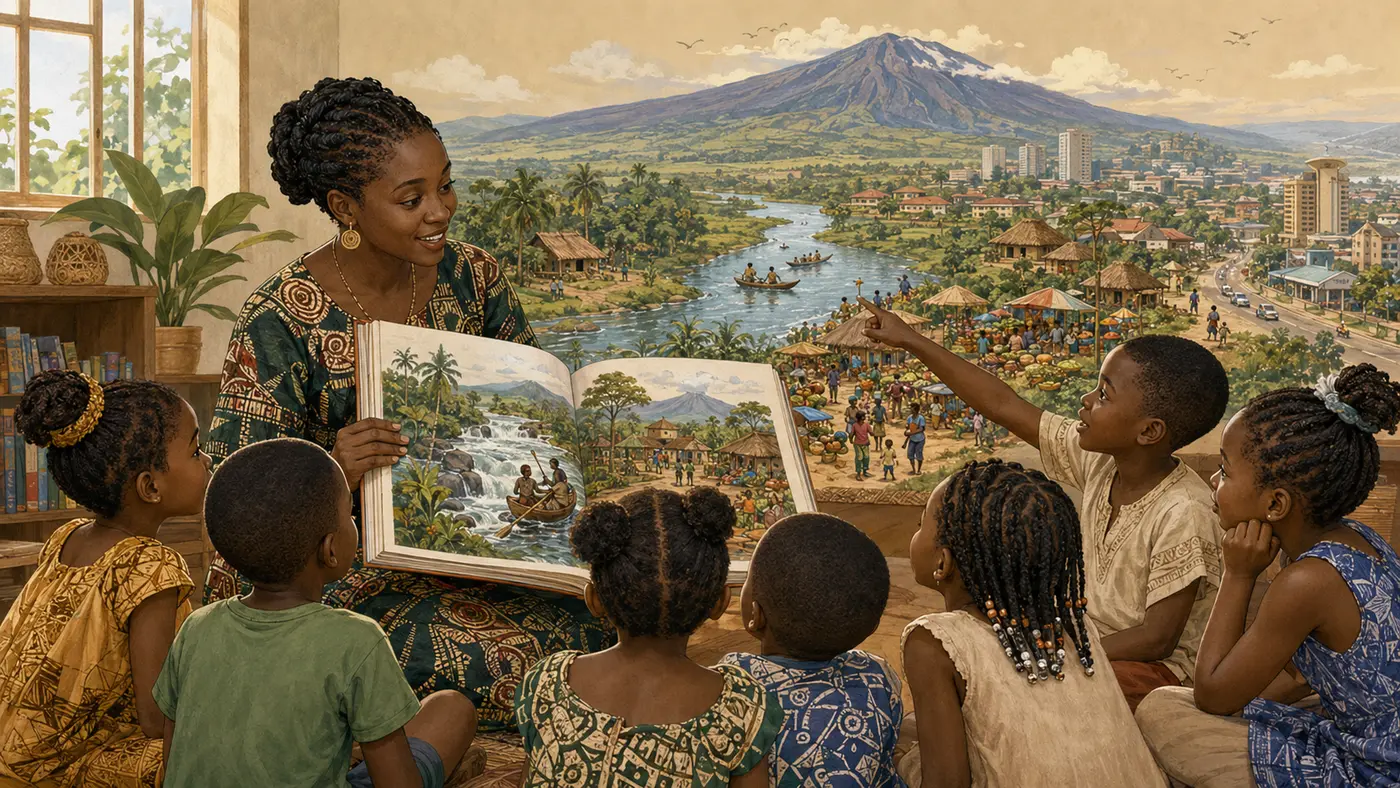
A reading passage feels more inviting when learners recognise the setting, an activity or the rhythm of the names. A journey from Buea to Limbe, a family preparing food in Garoua or children observing the Sanaga can give comprehension work a meaningful setting.
Local content must still be accurate and varied. Cameroon is not one village, one language or one type of landscape. Across a term, passages should include urban and rural life, different regions, girls and boys in active roles, many occupations and experiences that do not turn culture into a costume.
The questions should move beyond copying words. Begin with direct retrieval, then ask learners to explain a cause, predict an outcome, infer a feeling from evidence or connect the text to another idea. One short writing task can extend the passage without making the lesson too long.
Oral stories can also support literacy, but teachers should identify the storyteller or source where possible and avoid presenting one version as the only correct version. Learners can compare two tellings and discuss what remained the same.
A Cameroon-grounded text should open the learner’s world, not close it. Familiarity gives children a starting point; careful reading and curiosity carry them towards wider knowledge.
Text selection should match the reading purpose. A phonics passage needs controlled sound patterns; a comprehension text needs enough meaning for learners to retrieve, infer and discuss; a literature lesson may explore character, imagery or viewpoint. Teachers should not choose a long passage simply because it mentions Cameroon. Check sentence length, vocabulary load, background knowledge and the number of new ideas. A shorter, richer text often produces better discussion and more independent evidence than a page that learners cannot finish.
Prepare essential context without explaining the entire passage. If the setting is unfamiliar, locate it on a map, show one verified image or explain two necessary words. Then allow the text to provide information. Too much pre-teaching removes the need to read, while too little can make the task depend on knowledge some children have never encountered. The teacher should distinguish what the passage states from what learners already know and from what must be checked in another source.
Comprehension questions can be organised as a ladder. Begin with who, where, when and what. Move to how and why, then ask learners to support an inference with words from the text. A final question may compare, evaluate or apply the idea. When an answer is wrong, ask the learner to show the sentence that guided them. This makes reading evidence visible and allows the class to examine whether the difficulty came from vocabulary, attention, reasoning or an unclear question.
Stories also provide language models. Learners can collect sequence words, action verbs, dialogue punctuation or descriptive phrases, then use the pattern in a short new paragraph. Copying a model exactly is not the final goal. The teacher can change the setting, character or problem and ask learners to adapt the structure. This links reading and writing while reducing the fear of a blank page. Oral retelling before writing can help learners organise the sequence in their own words.
Cultural curiosity requires humility. If a story refers to a practice from a particular community, name the source or context and avoid claiming that everybody in the group behaves the same way. Invite learners to compare versions without deciding that one is primitive or superior. Historical passages should separate evidence from imagination. With these safeguards, Cameroon-centred reading can strengthen literacy, national knowledge and respect for difference while encouraging children to ask better questions about the country around them.
A class reading library can begin modestly with printed teacher-created texts, approved digital passages and learner-made books. Label reading levels carefully without publicly ranking children. Record the source and factual checks for local material. Invite learners to recommend a text and explain why. When children encounter Cameroon in varied, accurate stories—and also read beyond familiar settings—they learn that literacy is both a mirror of experience and a window into lives they have not yet known.
← Back to all articles