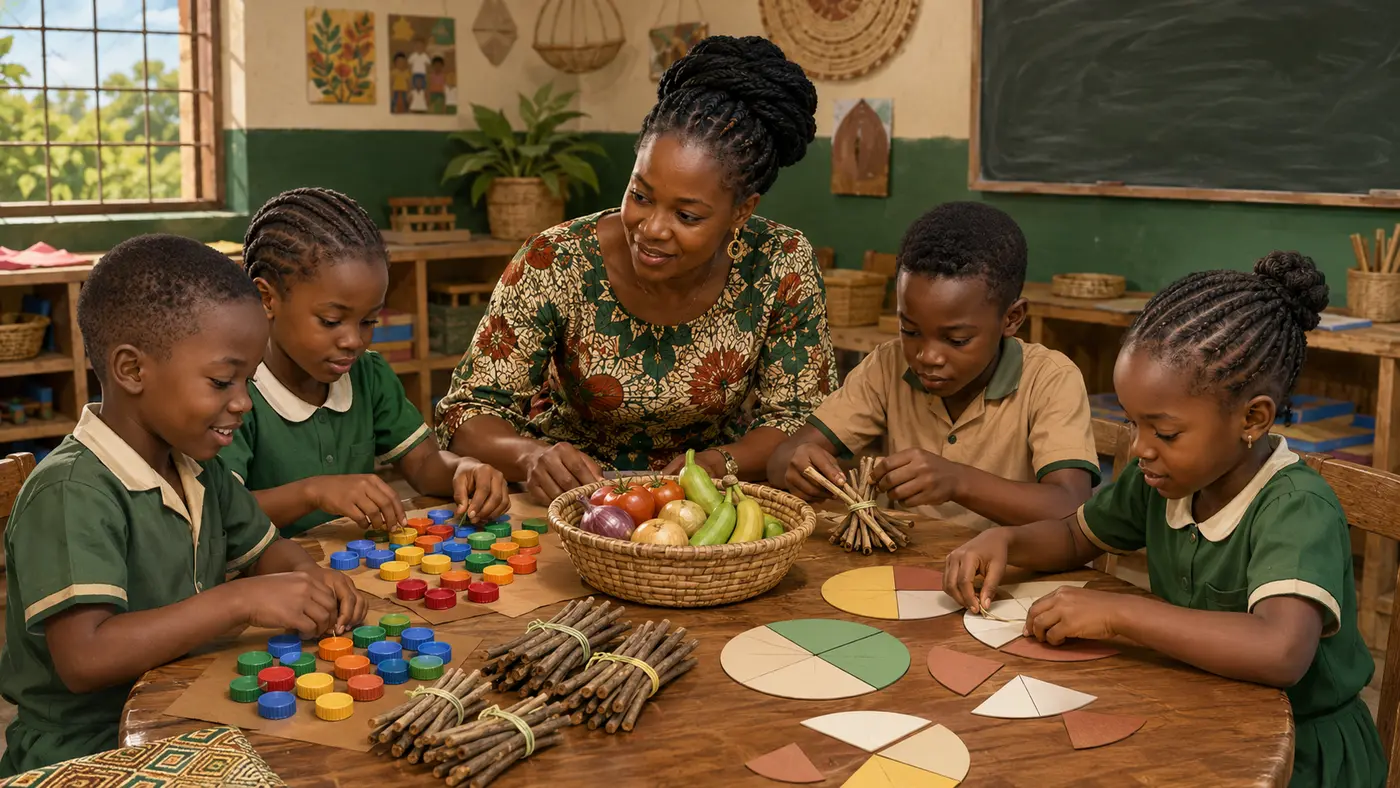
Mathematics becomes difficult when children are asked to remember symbols before they understand the quantities those symbols represent. A handful of clean bottle tops, beans, sticks or folded paper can make an invisible idea easier to see and discuss.
For addition and subtraction, learners can physically join or remove groups. Multiplication can begin with equal rows of objects. Fractions can be explored by folding paper or sharing a drawn pawpaw into equal parts. The material is not the lesson by itself; it is a bridge towards the number sentence.
Word problems should also sound believable. FCFA prices, distances between familiar places, school gardens and market quantities give learners a reason to decide which operation is needed. Keep the numbers suitable for the class and avoid adding local details that do not support the mathematical objective.
After using objects, ask learners to draw what happened and then write the symbols. This movement from concrete objects to pictures and finally to abstract numbers helps the teacher see whether a child understands or is only copying a method.
Low-cost teaching does not mean low expectations. Clear questions, careful vocabulary and short independent checks can turn ordinary classroom materials into strong mathematical learning.
Teachers should select materials that are clean, safe, large enough to handle and easy to count. Bottle tops need washing, sticks should have no sharp ends and beans or small objects may be unsuitable for very young children who still put items in their mouths. Each group needs enough materials to participate without creating an unmanageable distribution process. A simple container for each set saves lesson time and helps learners return complete quantities after the activity.
Questions should move from action to explanation. After learners make four groups of three objects, ask how many groups they see, how many objects are in each group, the repeated-addition sentence and the multiplication sentence. A learner who gives twelve may still not understand why four times three represents the arrangement. Inviting several explanations allows the teacher to notice whether children are counting one by one, skip-counting, using known facts or recognising an array.
Local word problems need realistic quantities and clear language. A Class 2 question should not require knowledge of wholesale market pricing, and an advanced business story should not hide the Mathematics under unnecessary detail. Use names and settings from varied parts of Cameroon over time. Check that the operation follows from the situation: sharing equally suggests division, equal groups may suggest multiplication, and comparing two quantities requires a clear relationship.
Moving to symbols is essential. After enough object practice, learners should sketch a representation and finally solve without the materials. Some children may return to objects when numbers become larger or a new operation is introduced. This is not automatically failure; it can show that the representation still supports reasoning. The teacher should gradually reduce prompts and observe whether the learner can choose a suitable method independently rather than removing materials according to a fixed date.
Assessment can remain practical while producing clear evidence. Give each learner a small set of objects and one instruction, then ask for a drawing and number sentence. Change the quantities to see whether the method transfers. Ask one error-analysis question, such as why 3 × 4 and 3 + 4 are not the same operation. Low-cost materials become powerful when the lesson includes precise vocabulary, structured questions and a deliberate path from doing to drawing, writing and explaining.
Teachers can organise a small Mathematics kit for each class or group using labelled recycled containers. Include counters, sticks, number cards, string, paper shapes and a simple measuring tool. Add or replace materials as topics change. Learners can help count and store items, building responsibility. The kit reduces preparation time because familiar representations remain available. What matters is not the price of the material but the precision of the task and the quality of the discussion built around it.
← Back to all articles